For most of the past decade, oil markets moved to the rhythm of supply and demand spreadsheets — OPEC+ quotas, shale output, seasonal demand swings. In 2026, that rhythm broke. A single conflict in the Middle East, a widening sanctions regime on Russia, and a scramble among Asian buyers to reroute their crude have reminded the world that oil is never just a commodity. It is a weapon, a bargaining chip, and a barometer of global power.
When the Strait Went Quiet
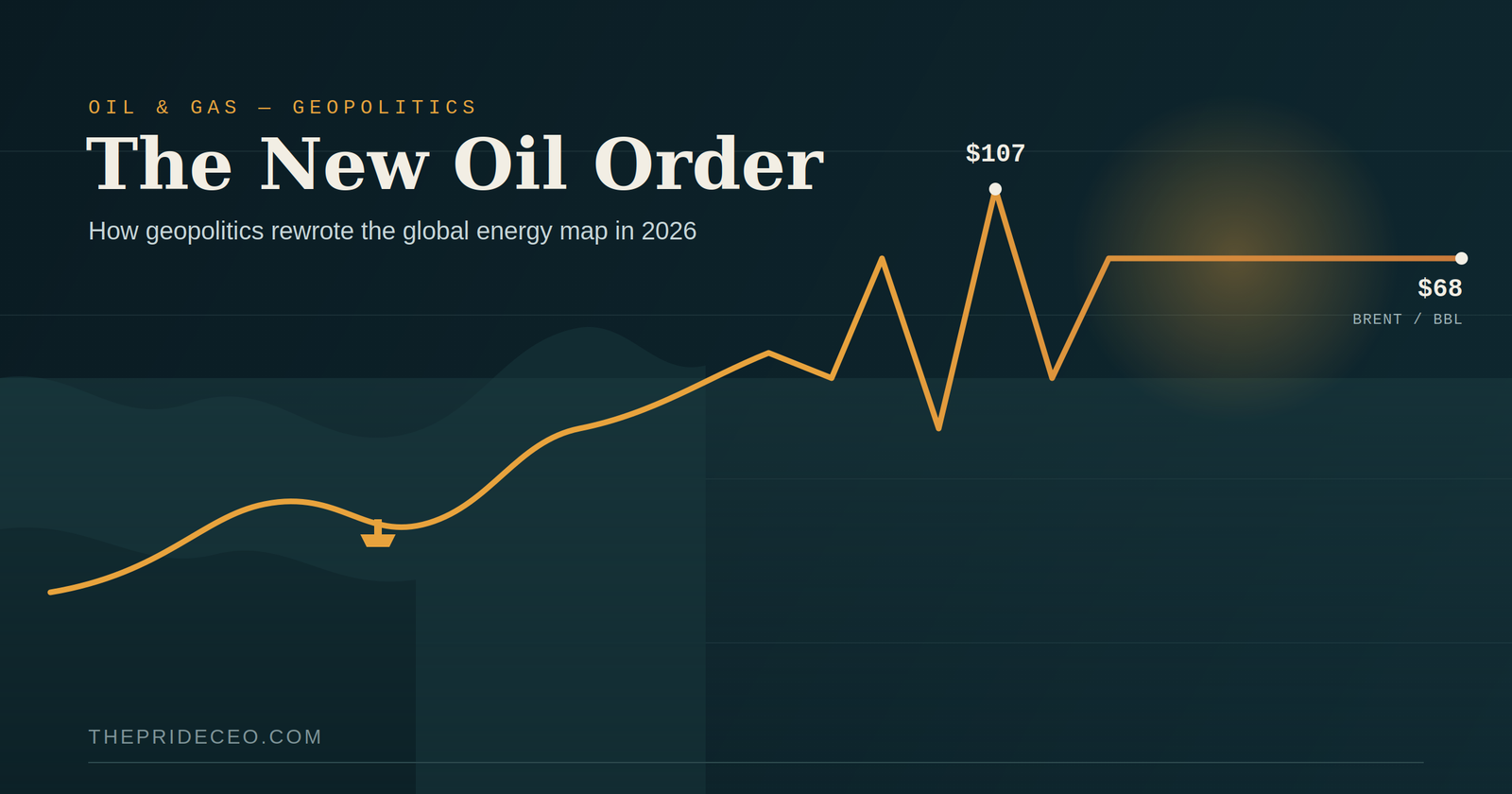
The turning point came in late February, when military action in the Middle East effectively shut down shipping through the Strait of Hormuz — the narrow waterway through which roughly a fifth of the world’s oil normally moves. Gulf producers, unable to move their crude, cut output by more than 11 million barrels a day at the peak of the disruption. Brent crude, which had opened the year near $60 a barrel on soft fundamentals, spiked past $100 and hovered above that level for months as global inventories drained to their lowest cushion in over two decades.
The knock-on effects were immediate and uneven. Diesel and jet fuel prices in the United States rose sharply as refiners scrambled for feedstock. Asian buyers, most dependent on Gulf supply, cut back demand faster than anywhere else. And a strange split emerged: Washington, no longer the swing importer it once was, became a net exporter of crude and refined products at record volumes, even as the rest of the world absorbed the shock.
From Crisis to Cautious Normal
By early summer, the picture had shifted again. Diplomatic progress between the United States and Iran — mediated in part by Qatar and Pakistan — opened the door to a fragile ceasefire and a gradual reopening of the strait. Saudi Arabia and the UAE quietly rebuilt their export volumes, in some cases routing tankers to avoid drawing attention to the recovering flows. By the first week of July, combined daily flows through Hormuz had climbed back above 10 million barrels, and Brent had fallen to the high $60s — its lowest level since before the conflict began.
That collapse in price was not just about supply returning. It was also a vote of confidence: traders started pricing in a durable peace rather than a temporary lull. OPEC+ read the same signals and responded by approving another round of production increases, adding roughly 190,000 barrels a day to collective output for the month ahead, led by Saudi Arabia and Russia. The group that spent the crisis defending price discipline is now managing the opposite problem — an emerging supply glut.
The Sanctions Reshuffle
Running underneath the Hormuz story is a second, quieter geopolitical shift: the reordering of who buys Russian oil. Nearly 70 percent of Russian crude is now under some form of sanction, and Washington has tied tariff relief for India directly to New Delhi’s willingness to cut its Russian imports. India has responded by scaling back purchases by several hundred thousand barrels a day — a retreat that has been almost entirely absorbed by China, where independent refiners and expanding storage capacity have made room for discounted Russian barrels.
The result is not less Russian oil moving globally, but a narrower, more concentrated set of buyers for it — a dynamic that leaves both Moscow and Beijing more exposed to shifts in the other’s policy, and one that Western sanctions architects will be watching closely as they calibrate the next round of restrictions.
Where Boardrooms Should Be Looking Next
For executives across energy, logistics, manufacturing, and finance, three threads are worth tracking heading into the second half of 2026:
1. Volatility is the new baseline, not the exception. Forecasters remain split on where prices land even a year out, with some seeing a structural glut pulling Brent toward the $60 range and others warning that any renewed friction around Hormuz, Venezuela, or Russian sanctions enforcement could send prices sharply higher again. Hedging strategies built for a stable-price world are due for a rethink.
2. Frontier supply is back in play. With Gulf risk elevated for much of the year, oil majors have started looking further afield — including a first licensing round in nearly two decades opening parts of Libya back up to international investment. Companies with exposure to logistics, drilling services, or project finance should watch for a wave of frontier and re-entry deals as majors diversify away from chokepoint-dependent supply.
3. Trade flows, not just prices, are the story. The India-to-China redirection of Russian barrels is a preview of a broader trend: sanctions and tariffs are increasingly reshaping where oil goes, not just what it costs. Firms with cross-border supply chains — energy-linked or not — should expect more of this kind of rerouting as governments use trade policy as a geopolitical lever.
The Bottom Line
Oil markets in 2026 have behaved less like a commodity market and more like a live geopolitical indicator — reacting within hours to diplomatic signals from Doha, tanker movements near Hormuz, and tariff announcements out of Washington. For business leaders, the lesson isn’t which direction prices will move next. It’s that the assumptions underpinning energy costs, trade routes, and supply security can shift in a single news cycle — and the companies that build flexibility into their planning now will be the ones least exposed when the next shock arrives.
This article is part of The Pride CEO’s ongoing coverage of the oil and gas sector. For more, visit our Oil & Gas section.