
Israel’s leaders have declared that Hamas will be wiped off the face of the Earth and Gaza will never go back to what it was.
“Every Hamas member is a dead man,” Prime Minister Benjamin Netanyahu said after fighters from the militant group killed 1,400 people in a brutal attack on Israel.
The goal of Operation Swords of Iron appears far more ambitious than anything the military has planned in Gaza before and could last months. But is its aim realistic, and how can its commanders possibly fulfil it?
A ground invasion of the Gaza Strip involves house-to-house urban fighting and carries immense risks to the civilian population. Air strikes have already claimed 3,000 lives, according to Gaza officials, and more than a million people have fled their homes.
Israel’s military has the added task of rescuing at least 199 hostages, held in unknown locations across Gaza.
Herzi Halevi, chief of staff of the Israel Defense Forces (IDF), has vowed to “dismantle” Hamas, and has singled out its political head in Gaza. But is there an ultimate vision for how Gaza will look after 16 years of Hamas’s violent rule?
“I don’t think Israel can dismantle every Hamas member, because it’s an idea of extremist Islam,” says military analyst Amir Bar Shalom of Israel’s Army Radio. “But you can weaken it as much as you can so it has no operational capabilities.”

That might be a more realistic objective. Israel has already fought four wars with Hamas, and every attempt to halt its rocket attacks has failed.
Michael Milstein, head of the Palestinian studies forum of Tel Aviv University, says destroying or weakening Hamas would be highly complicated. Quite apart from the 25,000-plus strength of Hamas’s military wing, the militant group has another 80-90,000 more members who are part of its social welfare infrastructure, or Dawa, he says.
IDF spokesman Lt Col Jonathan Conricus said by the end of this war Hamas should no longer have the military capacity to “threaten or kill Israeli civilians”.
Ground invasion fraught with risk
The military operation is at the mercy of several factors that could derail it.
Hamas’s armed wing, the Izzedine al-Qassam Brigades, will have prepared for an Israeli offensive. Explosive devices will have been set, and ambushes planned. It can use its notorious and extensive network of tunnels to attack Israeli forces.
In 2014, Israeli infantry battalions suffered heavy losses from anti-tank mines, snipers and ambushes, while hundreds of civilians died in fighting in a northern neighbourhood of Gaza City.
That is one reason Israel has demanded the evacuation of the northern half of the Gaza Strip to the south of the Wadi Gaza river.


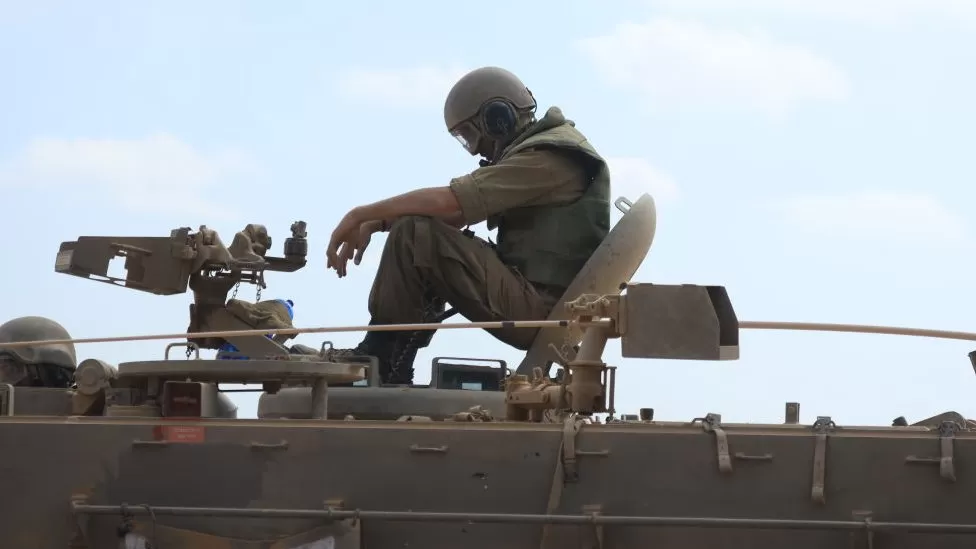
Israelis have been warned to prepare for a long war, and a record 360,000 reservists have reported for duty.
The question is how long Israel can continue its campaign without international pressure to pull back.
Gaza is rapidly becoming a “hell hole”, the UN’s refugee agency has warned. The death toll is rising fast; water, power and fuel supplies have been cut off.
“The government and military feel they have the backing of the international community – at least Western leaders. The philosophy is ‘let’s mobilise, we have plenty of time’,” says Yossi Melman, one of Israel’s leading security and intelligence journalists.
But sooner or later he believes Israel’s allies will step in if they see images of people starving. Pressure will also mount when civilians are killed on the ground.
“It’s very complicated because it needs time and the US administration won’t let you stay in Gaza for a year or two,” says Mr Milstein.