
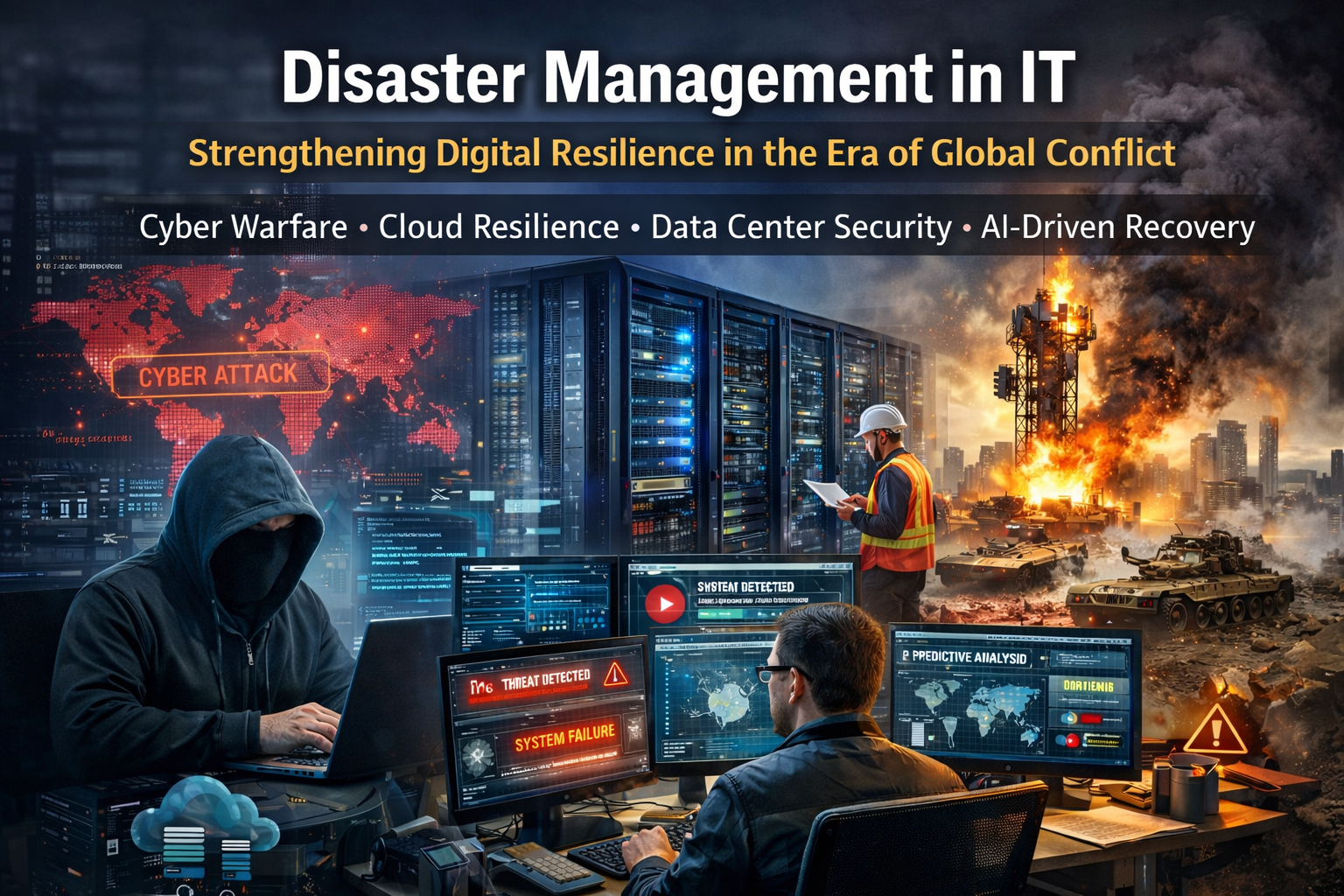
In 2026, the global economy operates on a digital backbone. Financial transactions, cloud infrastructure, healthcare systems, government services, and global supply chains all rely heavily on uninterrupted IT operations. However, the risk landscape has evolved dramatically. Alongside natural disasters and technical failures, geopolitical conflicts, cyber warfare, and infrastructure attacks are now major threats to digital systems worldwide.
As a result, disaster management in IT is no longer viewed as a secondary technical function. It has become a core strategic pillar for ensuring business continuity, protecting critical data, and maintaining operational resilience in an increasingly unpredictable global environment.
The New Reality: Digital Infrastructure as a Strategic Target
Modern conflicts have expanded beyond physical battlefields into cyberspace. Data centers, cloud platforms, satellite communication networks, and internet infrastructure are increasingly becoming targets during geopolitical tensions.
Recent global conflicts have demonstrated how digital infrastructure can be directly impacted.
Israel–Iran Conflict: Cyber Operations and Infrastructure Risks
The ongoing tensions between Israel and Iran have highlighted the growing importance of cyber warfare in modern conflicts. Both sides have engaged in cyber operations targeting government systems, financial institutions, and digital communication networks.
In addition to cyberattacks, physical infrastructure connected to digital services has also faced risks. Drone strikes and military operations in parts of the Middle East have raised concerns about the vulnerability of data centers and telecommunications networks.
Such events demonstrate how physical warfare and cyber warfare are now interconnected, forcing organizations to rethink their disaster preparedness strategies.
Russia–Ukraine War: The Rise of Hybrid Cyber Warfare
The Russia–Ukraine war has become one of the most prominent examples of hybrid warfare, combining military operations with large-scale cyberattacks.
Since the beginning of the conflict, cyber operations have targeted:
- Government digital infrastructure
- Energy grid systems
- Communication networks
- Financial institutions
These attacks aim to disrupt national services and create instability. As a result, organizations across Europe and beyond have accelerated investments in cyber resilience, cloud redundancy, and disaster recovery systems.
The war has demonstrated that cyberattacks can accompany physical conflict, affecting businesses and digital infrastructure far beyond the immediate battlefield.
Regional Instability: Afghanistan–Pakistan Tensions and Cyber Spillover
Political instability and cross-border tensions in regions such as Afghanistan and Pakistan have also increased cyber risks. Hacktivist groups and politically motivated cyber actors often launch attacks targeting government websites, telecom networks, and financial systems.
These incidents illustrate how regional conflicts can trigger cyber spillover effects, impacting organizations and digital networks in multiple countries.
For global enterprises and technology providers, this means that geopolitical developments must now be included in IT risk assessment and disaster planning frameworks.
From Disaster Recovery to Digital Resilience
Traditionally, IT disaster recovery focused on restoring systems after an outage or data loss. In 2026, the focus has shifted toward digital resilience—the ability of systems to continue functioning even during disruptions.
Organizations are increasingly adopting resilient infrastructure strategies such as:
- Multi-region cloud deployments
- Distributed data centers
- Edge computing networks
- Automated failover systems
These technologies allow critical applications to remain operational even if a data center or network segment becomes unavailable.
The shift from reactive recovery to proactive resilience represents a major transformation in IT disaster management.
Artificial Intelligence Transforming Disaster Management
Artificial intelligence is playing an increasingly important role in preventing and managing IT disasters.
AI-driven monitoring platforms analyze massive volumes of operational data to detect early signs of system failures or cyber threats. These systems can automatically trigger recovery mechanisms before disruptions escalate.
Key benefits of AI-powered disaster management include:
- Predictive infrastructure monitoring
- Real-time threat detection
- automated recovery workflows
- faster incident response
By leveraging AI and predictive analytics, organizations can significantly reduce downtime and operational risk.
Cloud Computing and Disaster Recovery as a Service
Cloud computing has transformed how organizations approach disaster recovery. Many enterprises now rely on Disaster Recovery as a Service (DRaaS) to replicate data and applications across multiple geographic locations.
Benefits of cloud-based disaster recovery include:
- Rapid system restoration
- reduced infrastructure costs
- automated failover capabilities
- global scalability
However, recent geopolitical developments have also highlighted the importance of geographic diversification. Organizations are increasingly adopting multi-cloud and hybrid cloud strategies to reduce dependency on a single provider or region.
Cybersecurity and Disaster Management: A Unified Approach
Cybersecurity has become inseparable from disaster management. As cyberattacks continue to grow in sophistication, organizations must integrate security frameworks directly into their disaster preparedness strategies.
Key components of modern cyber resilience include:
- Zero-trust security architecture
- immutable backup systems
- real-time threat intelligence
- automated incident response teams
This integrated approach ensures that organizations can quickly isolate compromised systems, prevent further damage, and restore services efficiently.
Testing and Simulation: Preparing for the Unexpected
An effective disaster recovery strategy must be regularly tested. Many organizations are conducting cyberattack simulations and disaster recovery drills to evaluate their preparedness.
These exercises allow IT teams to:
- identify vulnerabilities in infrastructure
- improve communication during crises
- train employees for emergency scenarios
- reduce recovery time objectives (RTO)
Continuous testing ensures that disaster management strategies remain effective as technology and threat landscapes evolve.
The Future of IT Disaster Management
As global digital ecosystems expand, disaster management strategies will continue to evolve. Emerging technologies such as autonomous IT operations, advanced threat intelligence platforms, and edge computing will further enhance system resilience.
In the future, organizations will increasingly rely on self-healing digital infrastructure, where intelligent systems detect disruptions and automatically restore services without human intervention.
Additionally, geopolitical risk analysis will become an essential component of IT planning, helping organizations anticipate potential disruptions caused by global conflicts.
Conclusion
In 2026, disaster management in IT has become a critical strategic priority for organizations worldwide. The growing influence of cyber warfare, geopolitical tensions, and attacks on digital infrastructure has fundamentally reshaped the global risk landscape.
Conflicts such as those involving Israel and Iran, Russia and Ukraine, and regional tensions in South Asia demonstrate that digital infrastructure is now a central battlefield in modern geopolitics.
Organizations that invest in resilient IT architecture, AI-driven monitoring, cloud-based disaster recovery, and integrated cybersecurity strategies will be better positioned to withstand disruptions and maintain operational stability.
In an era where data drives economies and digital systems power industries, building resilient digital infrastructure is no longer optional—it is essential for long-term global stability and business continuity.