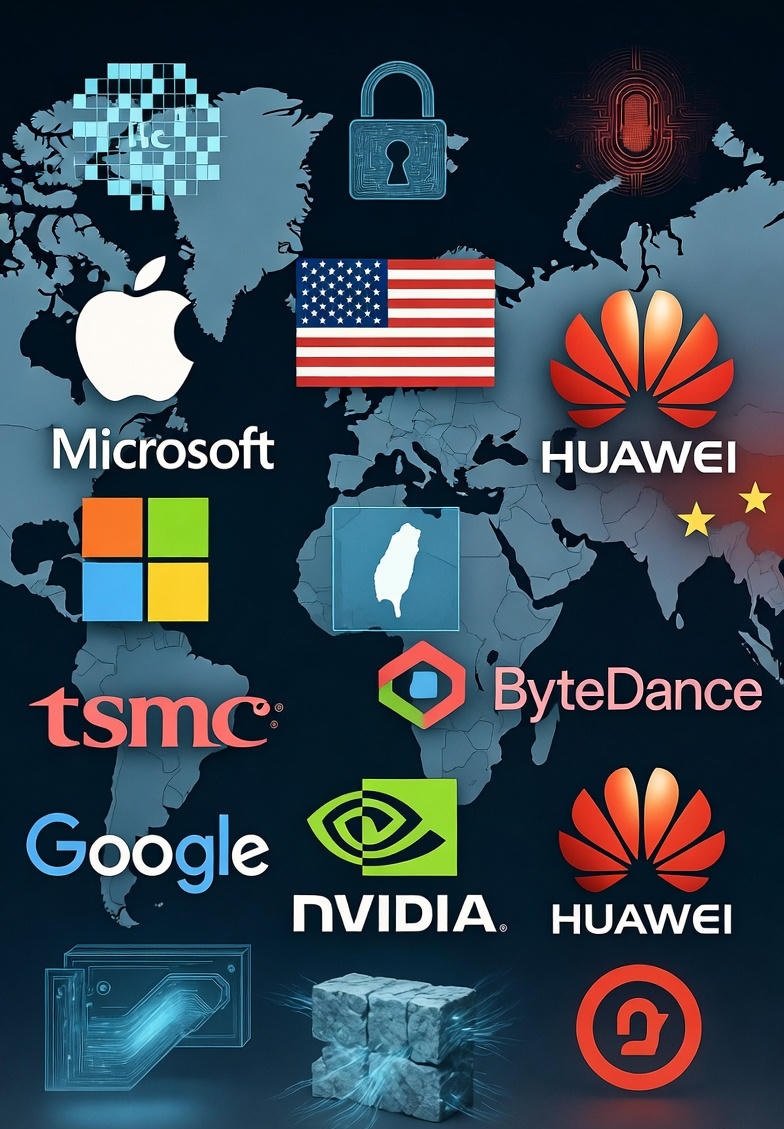
In 2025, the world’s largest technology companies—Apple, Microsoft, Google, Nvidia, TSMC, and emerging Chinese giants like Huawei and ByteDance—are no longer just competing on innovation and market share. They are now central actors in a new era of great-power rivalry, forced to navigate an increasingly hostile geopolitical landscape that threatens their supply chains, market access, revenue streams, and very business models.
The dominant fault line remains the U.S.–China technology decoupling. The Biden administration’s export controls on advanced semiconductors, first imposed in October 2022 and repeatedly tightened through 2025, have created a bifurcated global chip ecosystem. American firms such as Nvidia and ASML are prohibited from selling their most advanced tools and chips to Chinese entities. The Trump 2.0 administration, inaugurated in January 2025, has signaled even tougher measures, with proposals for 60–100% tariffs on Chinese goods and threats to revoke visas for Chinese STEM students. Beijing has responded with its own restrictions on rare-earth exports, antimony, and gallium, and aggressive subsidies under “Made in China 2025” and the subsequent “China Standards 2035” initiative. The result is a costly duplication of effort: companies are now building parallel supply chains—one for the U.S.-led bloc, another for China—at an estimated cost of hundreds of billions of dollars over the decade.
Taiwan occupies the most dangerous flashpoint. TSMC produces over 90% of the world’s most advanced logic chips. Any Chinese military action against the island would instantly cripple global technology production, from iPhones to AI training clusters. Apple has accelerated diversification efforts, moving some production to India and Vietnam, while Nvidia and AMD have pushed TSMC to expand in Arizona and Japan. Yet these new fabs remain years away from matching Taiwan’s efficiency and cost 30–50% more to operate. The “silicon shield” theory—that Taiwan’s semiconductor dominance deters invasion—looks increasingly shaky as Beijing’s military exercises grow more provocative.
Data sovereignty has become the second major battleground. The European Union’s GDPR, Digital Markets Act, and emerging AI Act impose stringent requirements that often conflict with U.S. and Chinese practices. India’s Digital Personal Data Protection Act (2023) and periodic app bans, Russia’s internet sovereignty laws, and Brazil’s LGPD have fragmented the once-borderless internet. Cloud providers like AWS, Azure, and Alibaba now maintain dozens of geographically isolated regions to comply with local storage mandates, dramatically increasing infrastructure costs. TikTok’s continued survival in the U.S. hangs on Project Texas—a costly data-isolation arrangement—while its European operations face mounting fines under the DMA.
Cyber espionage and forced technology transfer remain persistent risks. Western governments accuse Chinese firms of embedding backdoors and stealing IP; Beijing counters that American platforms serve as intelligence collection tools. The 2024–2025 wave of indictments against Chinese hackers targeting critical infrastructure has further chilled business sentiment.
For IT firms, the new imperative is geopolitical risk management at board level. Companies are appointing chief geopolitical officers, stress-testing supply chains against Taiwan invasion scenarios, and lobbying intensely in multiple capitals simultaneously. Some, like Ericsson and Nokia, have benefited from Huawei’s exclusion in Western 5G networks; others, like Apple, have seen their China revenue share drop from 25% in 2015 to under 17% in 2025 as domestic champions rise.
The era of frictionless globalization is over. Today’s tech giants must operate as quasi-sovereign entities, balancing shareholder value against national security imperatives of the countries that host their markets, talent, and factories. Those that fail to adapt risk becoming collateral damage in a new cold tech war.