Cloud Computing | Technology & Business
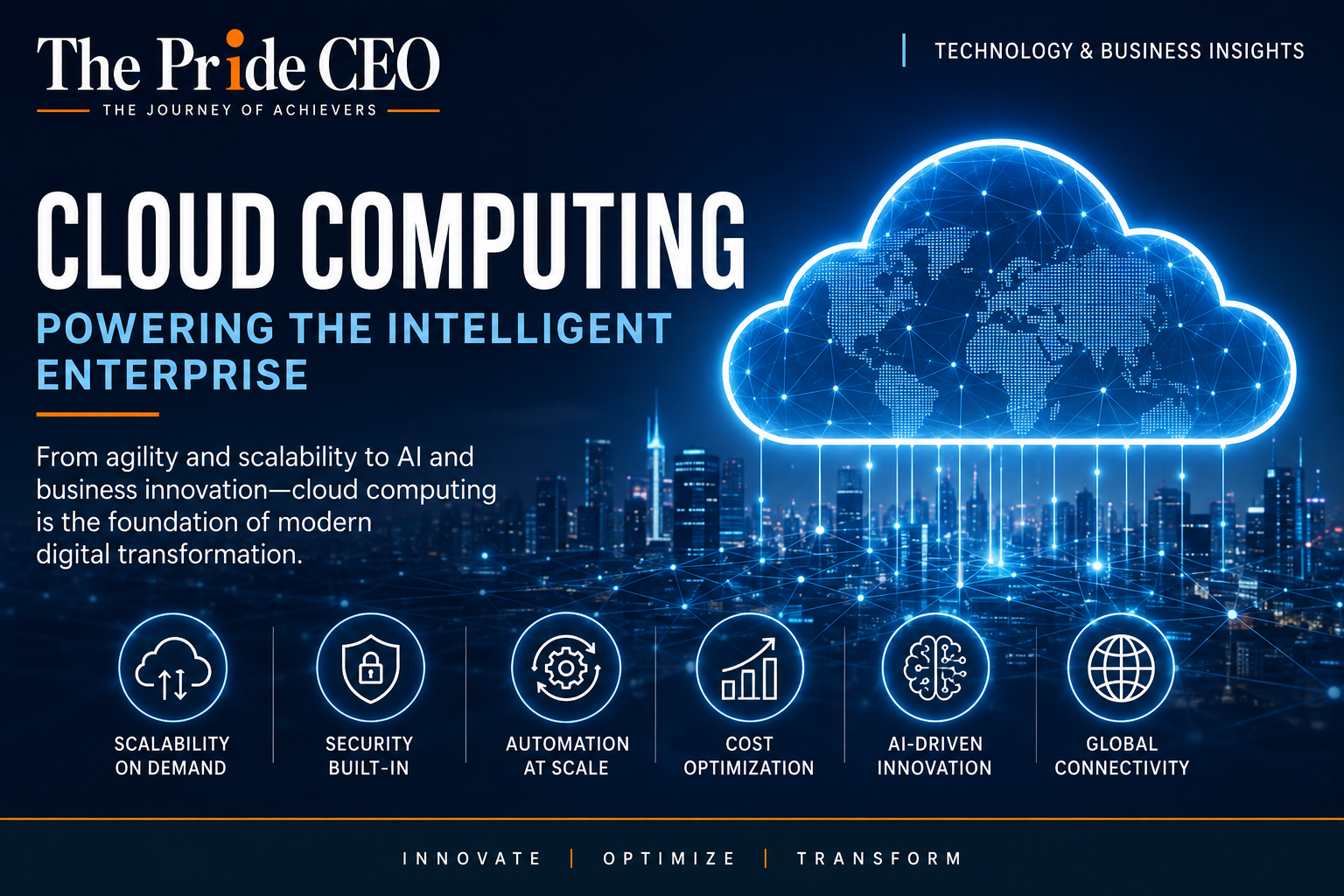
Cloud computing has spent more than a decade transforming the way organizations build, deploy, and manage technology. What began largely as a strategy for reducing infrastructure costs has evolved into something far more consequential: a foundation for business agility, artificial intelligence, data-driven decision-making, and digital resilience.
The next phase of cloud computing will not be defined simply by how many applications an organization moves to the cloud. Instead, the real question will be how effectively businesses use cloud capabilities to create measurable business value.
In 2026, organizations are entering an era in which cloud platforms are becoming intelligent operating environments. Applications, data, AI models, automation, security, and analytics increasingly work together across interconnected cloud ecosystems.
The result is a fundamental shift in the role of the cloud—from infrastructure provider to strategic business enabler.
From Cloud Migration to Cloud Transformation
For many organizations, the first cloud journey was straightforward: move applications and data away from traditional data centers and into public or private cloud environments.
That migration delivered important benefits, including scalability, flexibility, faster deployment, and access to modern infrastructure.
But migration alone is no longer enough.
Enterprises are now discovering that simply moving an inefficient application from an on-premises environment to the cloud does not automatically make it efficient. A poorly designed workload can remain expensive, complex, and difficult to manage regardless of where it operates.
The next generation of cloud strategy therefore focuses on cloud transformation.
This means redesigning applications, modernizing data architectures, automating infrastructure, strengthening cybersecurity, and connecting cloud investments directly to business objectives.
For technology leaders, the question is shifting from:
“How much of our infrastructure is in the cloud?”
to:
“What business outcomes are we achieving because of the cloud?”
That distinction will increasingly separate organizations that merely consume cloud services from those that use the cloud as a competitive advantage.
The Intelligent Cloud Era
Artificial intelligence is accelerating this transformation.
AI workloads require enormous amounts of computing power, specialized infrastructure, scalable storage, and rapid access to data. As organizations move AI from experimentation into production, cloud environments are becoming central to how these systems are developed and operated.
At the same time, AI is changing the cloud itself.
Intelligent automation can optimize workloads, identify unusual behavior, assist with application management, improve security monitoring, and help organizations predict infrastructure requirements.
AI-powered systems can also analyze enormous volumes of operational data and identify patterns that traditional monitoring tools may overlook.
This creates a feedback loop:
Cloud enables AI, while AI makes cloud environments more intelligent.
The emergence of agentic AI makes this relationship even more significant. AI agents increasingly require persistent access to applications, data, APIs, and computing resources. That means cloud architecture must evolve to support not only human users and conventional applications, but also autonomous digital workers.
Organizations will therefore need to rethink identity, permissions, monitoring, and governance for AI agents just as they have done for employees and applications.
Cloud Economics Becomes a Leadership Issue
Cloud was initially promoted partly on the promise of paying for infrastructure according to usage.
But as cloud environments have become more sophisticated—and AI workloads more computationally intensive—cloud economics has become considerably more complicated.
Organizations can accumulate substantial costs through unused resources, inefficient architectures, excessive data movement, poorly optimized workloads, and uncontrolled AI consumption.
This is why FinOps is becoming an increasingly important discipline.
FinOps brings finance, engineering, operations, and business teams together to understand technology consumption and connect it to business value.
The objective is not simply to reduce cloud spending.
It is to answer a more important question:
Is every dollar spent on cloud infrastructure generating an appropriate business return?
For CEOs and CFOs, this represents an important evolution. Cloud expenditure can no longer be treated solely as a technical operating cost. It increasingly requires the same strategic discipline applied to other major business investments.
The Rise of Cloud-Native Business
Another important shift is the movement toward cloud-native organizations.
Cloud-native does not simply mean running applications on cloud servers. It involves designing systems around scalability, automation, APIs, containers, microservices, continuous delivery, and highly flexible infrastructure.
This approach enables organizations to release products faster and respond more quickly to changing customer expectations.
A financial institution, for example, can introduce digital services without rebuilding its entire technology infrastructure. A retailer can scale computing resources during periods of unusually high demand. A healthcare organization can connect data and applications across different environments while maintaining appropriate security controls.
The underlying principle is simple:
Technology should adapt to the business—not force the business to adapt to technology.
This is one of the most important reasons cloud-native architecture is becoming central to digital transformation strategies.
Hybrid Cloud Will Remain Critical
Despite the rapid expansion of public cloud, the future is unlikely to be entirely public cloud.
Many enterprises operate in environments where certain workloads must remain on-premises or within dedicated infrastructure because of regulatory requirements, latency considerations, security policies, legacy dependencies, or operational needs.
As a result, hybrid cloud will remain an important enterprise architecture.
A modern organization may simultaneously operate:
- Public cloud platforms
- Private cloud infrastructure
- On-premises systems
- Edge computing environments
- Specialized AI infrastructure
The challenge is making these environments operate as one coherent technology ecosystem.
This requires consistent identity management, security policies, observability, data governance, automation, and application management across environments.
The objective is not necessarily to eliminate complexity. It is to control complexity.
Cloud Security Moves to the Center
As more critical business processes move into interconnected cloud environments, cybersecurity becomes inseparable from cloud strategy.
Traditional security models often assumed that applications and data existed within a clearly defined corporate perimeter.
Cloud environments have changed that assumption.
Employees may access applications from anywhere. Applications communicate through APIs. Data can move between multiple environments. AI agents may interact with business systems autonomously. Third-party services can become deeply integrated into enterprise workflows.
This makes identity one of the most important components of modern cloud security.
Organizations increasingly need to verify not only who is accessing a resource, but also what device, application, service, or AI agent is requesting access.
Zero Trust principles therefore become increasingly relevant to cloud environments.
Security must be continuous rather than occasional, with organizations monitoring identities, workloads, applications, APIs, data, and infrastructure for abnormal behavior.
Cloud and Data Become One Strategic Conversation
The value of cloud infrastructure ultimately depends on the value organizations can extract from their data.
As businesses deploy more AI and analytics applications, data architecture becomes increasingly important.
Enterprises need systems that can collect, process, govern, protect, and analyze data across multiple environments.
This is pushing organizations toward modern data platforms capable of supporting real-time analytics, machine learning, business intelligence, and AI applications.
The challenge is no longer simply storing enormous quantities of information.
The challenge is making data:
Accessible. Trusted. Governed. Secure. Actionable.
Cloud platforms provide the infrastructure to achieve this at scale, but organizations still need strong data governance and clear ownership.
Without those foundations, the cloud can simply make bad data available faster.
Cloud Resilience Becomes a Competitive Advantage
Business continuity has also taken on new importance.
Organizations increasingly recognize that cloud availability does not automatically equal business resilience.
A company can still experience major disruption if it relies too heavily on a single region, provider, application dependency, or external service.
Modern cloud strategies therefore increasingly consider redundancy, disaster recovery, workload portability, automated recovery, and geographically distributed infrastructure.
Resilience is becoming more than a technical requirement.
It is a business capability.
Companies that can recover quickly from infrastructure failures, cyber incidents, supply-chain disruptions, or unexpected demand can protect customer relationships and continue operating while competitors struggle.
The Executive Cloud Agenda
The future of cloud computing will require stronger collaboration between technology and business leadership.
CIOs and CTOs will increasingly need to work with CEOs, CFOs, security leaders, and business-unit executives to answer questions such as:
- Which workloads genuinely benefit from cloud modernization?
- Where should sensitive data and applications reside?
- How should AI infrastructure costs be governed?
- How resilient is the current cloud architecture?
- Are security policies consistent across environments?
- How dependent is the organization on a single provider?
- Can technology investments be directly connected to business outcomes?
- Does the organization have the skills required to operate increasingly complex cloud environments?
These are no longer purely technical questions.
They are strategic questions about competitiveness, risk, capital allocation, innovation, and customer experience.
The Road Ahead
Cloud computing is entering a more mature phase.
The early cloud era was largely about migration. The next era will be about intelligence, optimization, resilience, governance, and measurable business value.
AI will increase the demand for computing resources. Hybrid and multi-cloud environments will become more sophisticated. Cloud economics will receive greater executive attention. Security and identity will become increasingly important. Data will remain the foundation connecting cloud applications with business intelligence and AI.
For enterprises, the winners will not necessarily be those that spend the most on cloud.
They will be the organizations that build the right cloud strategy for their business.
The future belongs to companies that can combine scalable infrastructure with intelligent applications, trusted data, strong security, disciplined economics, and resilient operations.
Cloud computing is no longer simply about where technology lives.
It is about how intelligently an organization operates.
And that makes the cloud one of the most important strategic platforms shaping the future of business.