
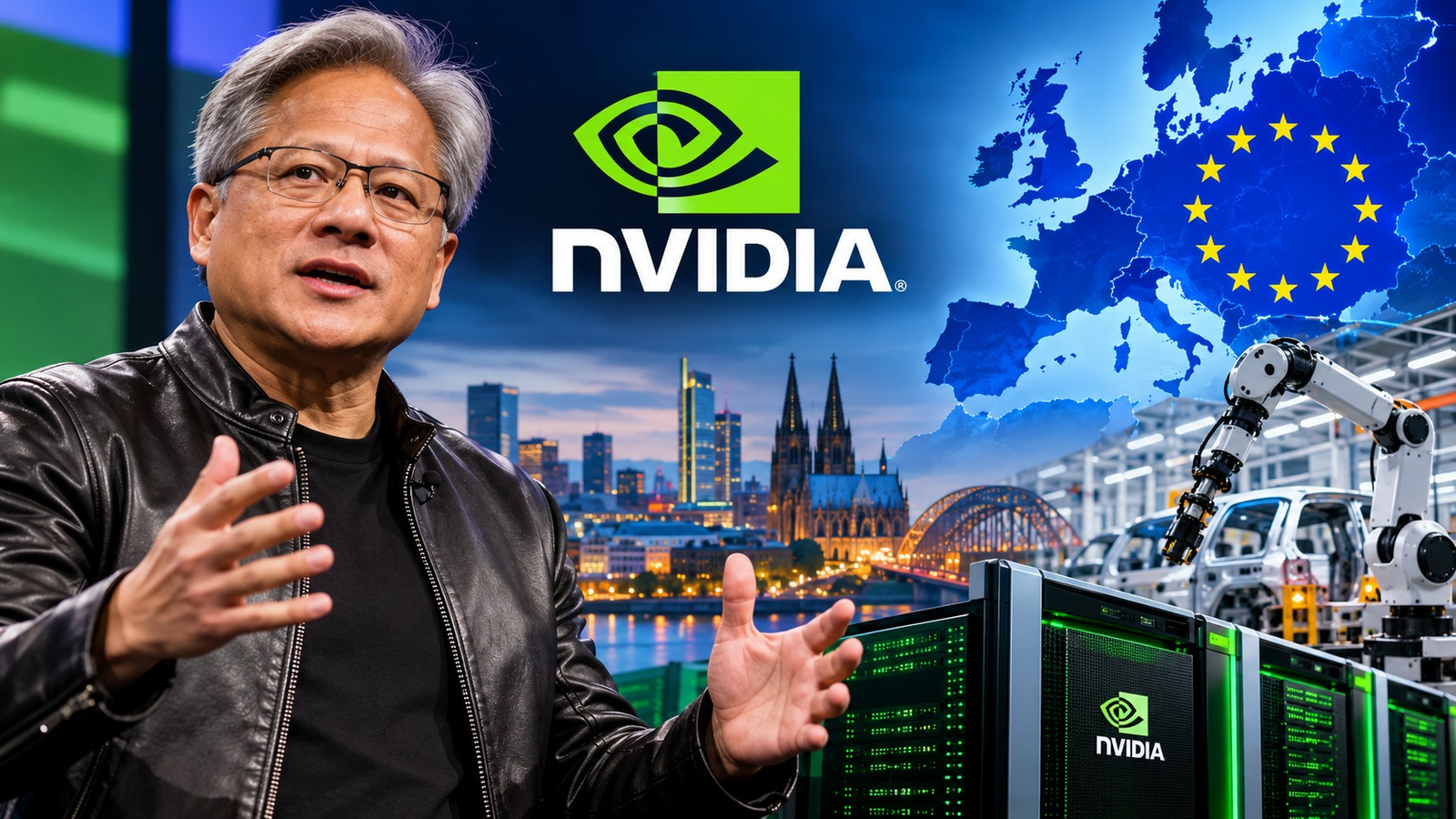
The NVIDIA chief argues that artificial intelligence could reshape manufacturing, robotics and national economies, urging European countries to move faster while balancing innovation with safety.
Europe Must Move Faster in the AI Race
NVIDIA CEO Jensen Huang has delivered a strong message to European leaders: accelerate artificial intelligence development or risk falling behind global competitors. During his recent European tour, Huang emphasized that AI is no longer limited to chatbots, software development and digital services. Its next major phase could transform manufacturing, robotics, transportation and other industries that form the backbone of modern economies.
Huang’s remarks come as governments worldwide compete to build AI infrastructure, attract investment and develop domestic technological capabilities. His visit to Europe, including discussions with German Chancellor Friedrich Merz, highlights the growing importance of AI in economic policy and industrial strategy.
According to recent reporting by Business Insider and the Associated Press, Huang has encouraged Europe to make better use of its engineering expertise, industrial knowledge and research capabilities rather than allowing excessive caution to slow innovation.
The Next AI Revolution Could Be Physical
For years, public discussion about AI has concentrated on generative AI tools, automated writing, image generation and digital assistants. Huang believes the next major opportunity lies in applying intelligence to the physical world.
This includes AI-powered robots, autonomous machines, intelligent vehicles and automated industrial facilities. In manufacturing, AI systems could help companies identify equipment failures before they occur, improve production efficiency, reduce waste and optimize supply chains.
Germany, with its established automotive sector and advanced engineering capabilities, could be particularly well positioned to benefit from this transition. Smaller and medium-sized manufacturers may also gain access to technologies that were previously affordable only to large corporations.
However, successfully adopting industrial AI will require more than purchasing advanced chips. Companies will need skilled employees, reliable data, cybersecurity safeguards and investment in modern computing infrastructure.
NVIDIA’s Expanding Role in the Global AI Economy
NVIDIA has become a central supplier of the advanced computing hardware used to train and operate many modern AI systems. Its graphics processing units, networking technologies and software platforms support AI development across cloud computing, research, enterprise applications and increasingly industrial automation.
As more countries seek to develop their own AI capabilities, demand for computing infrastructure is creating new opportunities for NVIDIA.
Huang has promoted the concept of sovereign AI—the ability of countries to develop and operate AI systems using their own data, infrastructure, talent and local expertise. Governments increasingly view this capability as strategically important for economic competitiveness, public services and national security.
Yet this ambition creates a paradox. Countries may want greater technological independence while relying on a relatively concentrated global supply chain for advanced chips and computing systems.
For NVIDIA, the expansion of sovereign AI initiatives could create additional demand for its technology. For governments, the challenge is to build domestic expertise without becoming excessively dependent on a small number of external suppliers.
Innovation Versus Regulation: Finding the Right Balance
Huang has also urged policymakers to avoid regulatory approaches that could unnecessarily slow technological progress. His position is that governments should protect people and manage the risks of AI while allowing researchers and businesses sufficient freedom to innovate.
The debate is especially relevant in Europe, where policymakers have introduced comprehensive AI rules and continue to consider how to govern emerging applications.
Supporters of stronger regulation argue that safeguards are essential to address privacy violations, discrimination, cybersecurity threats and potentially harmful automated decisions. Others warn that complex compliance requirements could disproportionately affect startups and smaller companies.
The challenge is not simply choosing between regulation and innovation. Effective policy must establish clear responsibilities, protect fundamental rights and provide predictable rules without preventing beneficial research and commercial development.
NVIDIA also has a direct commercial interest in faster AI adoption, meaning Huang’s views should be considered alongside the company’s position as a major supplier to the industry.
AI Safety Remains a Critical Question
The rapid growth of AI has raised concerns about cyberattacks, misuse, unreliable automated decisions and the security of increasingly autonomous AI agents.
Huang has argued that companies should take these risks seriously and develop stronger technical safeguards. In recent interviews, he has discussed the importance of controlling AI systems and preventing cybersecurity incidents.
For businesses adopting AI, these issues are becoming practical management concerns rather than distant possibilities. Organizations must consider what information an AI system can access, which actions it can perform, how its decisions are monitored and who remains accountable when something goes wrong.
A successful AI strategy must therefore combine investment and experimentation with security, governance and human oversight.
What This Means for Businesses Worldwide
Huang’s message has implications far beyond Europe. Businesses in Asia, North America and emerging markets face similar decisions about how quickly to adopt AI and how to prepare their workforces.
Companies that integrate AI into existing operations may gain advantages in productivity, customer service, research and product development. Manufacturers could use AI to optimize production, while financial institutions could apply it to fraud detection and risk analysis.
However, organizations should not adopt AI simply because competitors are doing so. They need to identify specific business problems, assess the quality of their data, calculate implementation costs and establish measurable performance targets.
For smaller businesses, beginning with limited, practical applications may be more effective than making large investments in complex systems without a clear business case.
The Road Ahead
Jensen Huang’s latest comments reflect a broader shift in the global AI debate. The question is increasingly moving from whether artificial intelligence will transform industries to which countries and companies are prepared to implement it effectively.
Europe has significant industrial expertise and research capabilities, but converting these strengths into commercial leadership will require investment, skills development and collaboration between governments, universities and businesses.
At the same time, the global race for AI leadership cannot be measured solely by computing power or the speed of deployment. Safety, economic value, workforce readiness and public trust will also influence long-term success.
As AI moves from digital applications into factories, vehicles and physical infrastructure, the next stage of competition could reshape how economies produce goods, deliver services and create jobs.
For business leaders, the message is clear: AI is becoming a strategic consideration across industries, and preparation today could determine competitiveness tomorrow.