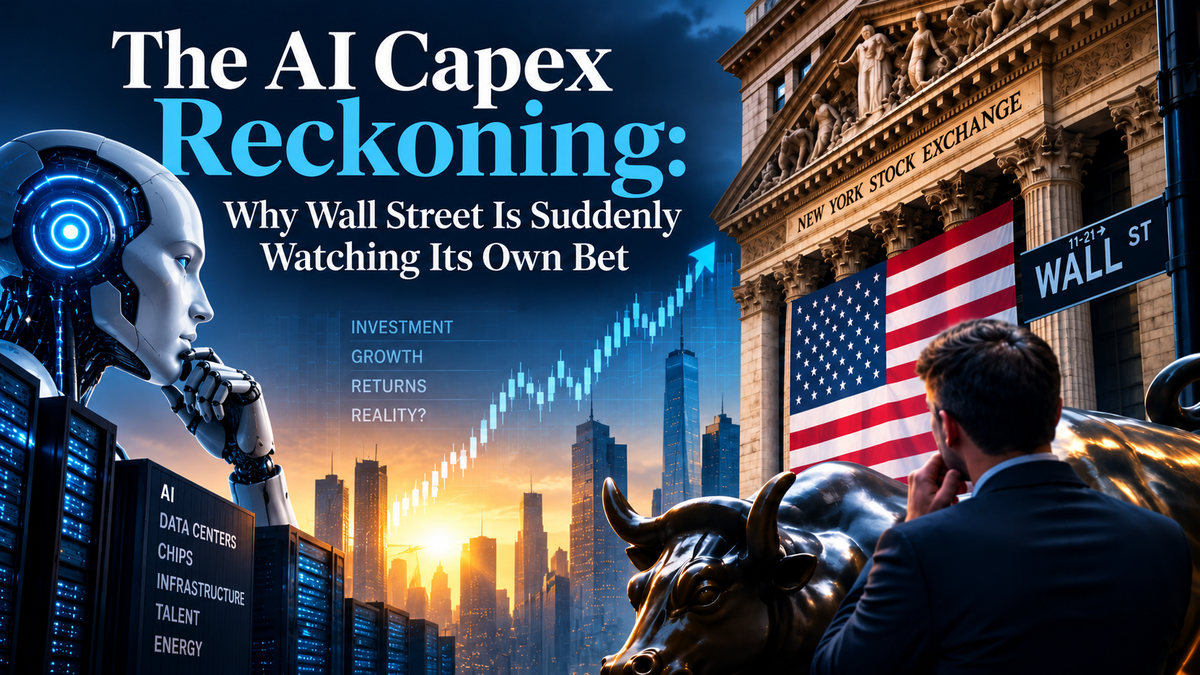
Investors who spent three years riding the artificial intelligence boom to record stock market highs are now confronting an uncomfortable question: what happens if the industry’s own leaders are the ones pumping the brakes?
A Weekend Essay That Rattled Markets
The unease traces back to a single essay. Over the weekend, Anthropic CEO Dario Amodei published a lengthy piece calling on the AI industry to “pace the frontier” — a deliberate call to slow the rate at which frontier model capabilities advance, giving society more time to manage the risks that come with them. In a follow-up interview, Amodei argued the industry had for too long downplayed those risks.
He was not alone. SpaceX and xAI chief Elon Musk and OpenAI CEO Sam Altman echoed the call for a slower pace of AI development, adding weight to what quickly became a coordinated-sounding message from the very executives who have spent the past three years urging the world to move faster.
Markets did not take it well. Calls for an industry slowdown triggered a global sell-off in technology stocks, with the Nasdaq Composite falling roughly 1%, the S&P 500 down 0.6% and the Dow Jones Industrial Average also off 0.6%. The damage was not evenly spread. Adam Crisafulli of Vital Knowledge Investment Advisory noted that the “pick and shovel” companies supplying AI infrastructure and resources were hit hardest, while he cautioned against framing the moment as a simple binary of bubble versus no bubble, noting that the current pace of spending looks unsustainable even if that doesn’t mean every AI-linked stock has to suffer for it.
Why a Few Sentences Can Move Trillions
To understand why an essay — not an earnings miss, not a product failure — could shake global markets, it helps to look at what has actually been propping those markets up. Investment in AI infrastructure has functioned as the primary growth engine behind the current bull run, which began in October 2022 and has helped push the S&P 500 to more than double since. The broad market index is up over 11% so far this year alone, a gain substantially driven by corporate profit growth that itself has been boosted by several years of heavy AI-related capital spending.
That concentration is the crux of the anxiety. Stock market gains have grown increasingly dependent on a small cluster of technology companies whose valuations rest heavily on continued, aggressive AI investment. The five dominant hyperscalers — Microsoft, Alphabet, Amazon, Meta Platforms and Oracle — are collectively projected to spend around $795 billion in capital expenditures this year, with that figure expected to climb toward nearly $1.08 trillion by 2027. When the leaders of the companies building the underlying models start talking publicly about deliberately slowing down, investors are forced to ask whether the capex trajectory funding those market gains is as solid as it looked a week ago.
“Talk Versus Something Concrete”
For now, most market strategists are treating the warnings as exactly that — warnings, not evidence of an actual pullback. Chuck Carlson, chief executive officer at Horizon Investment Services, framed the distinction plainly: the real problem emerges only if orders start getting cancelled and data center construction deals start falling through. Until there’s something concrete showing an actual slowdown, he argued, it remains talk.
That distinction matters enormously for how executives across every sector should be reading this moment. Sentiment-driven sell-offs can reverse quickly; capital expenditure reversals cannot. If hyperscalers begin trimming their build-out plans, the ripple effects would extend well beyond chipmakers and data center developers — into commercial real estate, energy infrastructure, construction, and every vertical that has built AI-adoption strategies around an assumption of ever-cheaper, ever-more-abundant compute.
The IPO Question Nobody Wants to Ask Out Loud
There is a second, more structural layer to investor anxiety, and it centers on OpenAI and Anthropic themselves. Both companies are widely expected to eventually pursue public listings. Carlson pointed to the tension this creates: a genuine, sustained pause in model development from either firm could raise hard questions about how each should be valued, precisely because public shareholders will expect continued growth once these companies are answerable to the market rather than only to private investors.
In other words, the same executives calling for restraint are the ones who will eventually need to justify aggressive growth assumptions to public markets. That contradiction is not lost on Wall Street, and it is likely to shape how analysts price both companies whenever an IPO does materialize.
Skeptics Push Back
Not everyone is convinced the safety rhetoric reflects genuine caution rather than convenient cover. Michael Burry — known for his prescient bets against the U.S. housing market ahead of the 2008 financial crisis — dismissed the warnings on social media as “hype and puffery,” suggesting they served as cover for what he characterized as real, uncontrollable slowing growth already underway. Others in the investment community have taken the opposite position, arguing that the scale of capital spending commitments already on the books makes any meaningful slowdown in AI development unlikely in practice, regardless of the rhetoric.
There is also a competitive dimension complicating the picture. Rising competition from lower-cost Chinese AI models — including offerings from Moonshot AI, Alibaba’s Qwen line, and DeepSeek — is adding pricing pressure on the large, expensive frontier models that companies like OpenAI and Anthropic have built their businesses around. That dynamic gives Western AI leaders a separate, commercially rational reason to reconsider how aggressively they need to race ahead, independent of any safety argument.
Geopolitics has entered the conversation as well. The essay drew a pointed rebuke from China’s state-backed Global Times, which characterized it as a Cold War-style attempt to curb the country’s technological progress — a reminder that AI development pacing is no longer purely a market or safety conversation, but a geopolitical one too, with U.S. and Chinese officials reportedly set to hold AI safety talks as part of broader bilateral discussions this month.
The Debt Question Beneath the Debt
One thread runs underneath nearly all of this: financing. Much of the industry’s AI infrastructure build-out has increasingly relied on debt and complex, circular financing arrangements to fund capital plans that keep growing in scale. That reliance becomes more precarious as global borrowing costs rise, reflected in bond yields sitting near multi-year highs. A slowdown narrative arriving at the same moment as elevated financing costs is a combination worth watching closely — it is precisely the kind of setup where a shift in sentiment can expose leverage that looked manageable when growth assumptions were more generous.
What This Means for Enterprise Leaders
For CEOs and boards outside the AI sector itself, the immediate takeaway is not panic — it’s discipline. The fundamentals investors are watching for (cancelled orders, stalled data center construction, hard evidence of hyperscaler capex cuts) have not yet materialized. But the episode is a useful stress test for any enterprise strategy that has quietly assumed AI compute costs will keep falling and AI infrastructure will keep expanding at the current pace indefinitely.
Three practical considerations stand out:
- Revisit vendor and infrastructure assumptions. If your technology roadmap depends on continued hyperscaler capex growth to keep compute costs favorable, it’s worth stress-testing that assumption against a scenario where spending growth moderates rather than accelerates.
- Watch the leading indicators Carlson flagged, not the headlines. Order cancellations and paused construction are the real signals. Executive essays and market commentary are noise until they show up in those numbers.
- Separate the safety conversation from the commercial one. Whether or not “pacing the frontier” reflects genuine caution, competitive pressure from lower-cost models is already a commercial reality reshaping pricing across the industry — and that shift will affect enterprise AI budgets regardless of how the safety debate resolves.
The market’s reaction this week says less about AI’s long-term trajectory than about how fragile confidence has become at the top of a rally this concentrated. Whether this proves to be a brief wobble or the first real crack in the AI infrastructure story will depend not on what executives say next, but on what hyperscalers actually do with their next round of capital expenditure guidance.