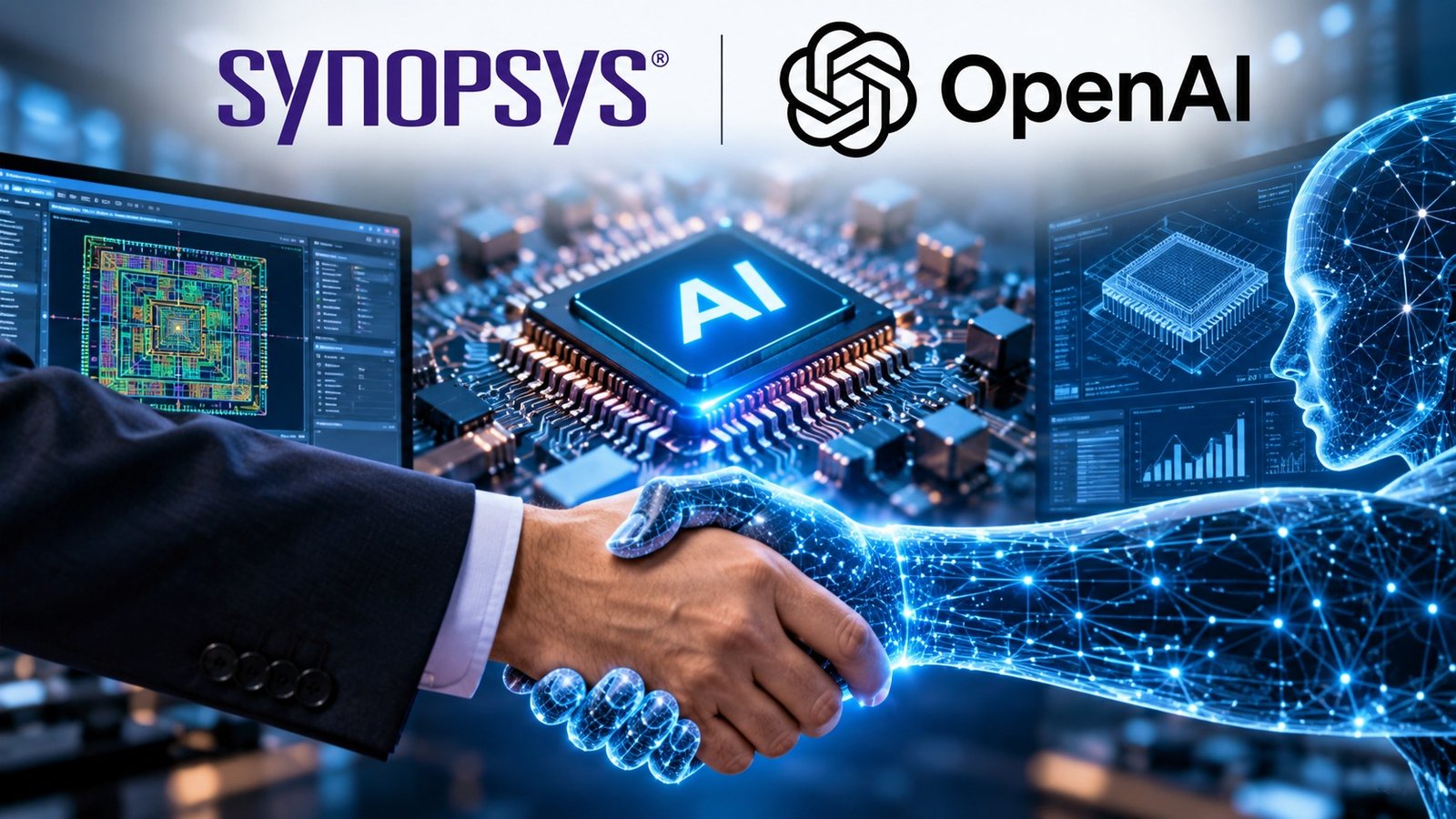
Synopsys and OpenAI are joining forces to bring frontier artificial intelligence directly into semiconductor design, creating a specialized AI model that could change how engineers develop increasingly complex chips. The partnership also introduces a notable commercial structure: the two companies will share revenue generated by the technology.
Synopsys and OpenAI announced a multi-year strategic partnership on September 30 to jointly develop and deliver GPT-Synopsys, a specialized AI model designed specifically for semiconductor engineering. The model will combine OpenAI’s advanced AI capabilities with Synopsys’ electronic design automation (EDA) software and decades of chip-design expertise.
The companies say the goal is to make AI capable of operating chip-design tools more like an expert engineer—interpreting results, exploring alternatives and repeatedly optimizing designs.
From AI assistant to AI chip-design engineer
Modern chip design is an extremely complex process involving everything from describing circuits and architectures to placing and routing billions of transistors on a tiny piece of silicon.
GPT-Synopsys is being developed to work directly with Synopsys’ EDA tools throughout these workflows. Rather than simply generating suggestions, the model is intended to interact with engineering tools, interpret their outputs and iterate on designs.
That could allow engineers to evaluate substantially more design alternatives while optimizing key semiconductor metrics such as power, performance and area (PPA).
OpenAI President and co-founder Greg Brockman said the partnership is aimed at helping engineers explore more designs and reach working chips faster.
Revenue sharing makes the partnership different
One of the most significant elements of the agreement is its shared-revenue framework.
OpenAI will license Synopsys’ EDA tools to help develop the specialized model, while the companies will collaborate on research, development and go-to-market activities. Revenue generated when customers use GPT-Synopsys will then be shared between the two companies.
According to Synopsys CEO Sassine Ghazi, OpenAI will pay Synopsys a training subscription fee while the model learns to use Synopsys’ software. Once customers begin using the product, revenue sharing will be linked to the value the system delivers in improving chip designs.
The structure effectively gives both companies an incentive to make the model useful in real semiconductor engineering environments rather than treating the project simply as a conventional software licensing arrangement.
Synopsys wants AI to expand—not threaten—its business
The deal also addresses a major question facing electronic design automation companies: could generative AI eventually reduce demand for traditional engineering software?
Synopsys is taking the opposite approach.
Instead of allowing general-purpose AI systems to operate around its EDA ecosystem, the company is working with OpenAI to make its tools part of the AI workflow.
Ghazi told Reuters that the agreement was designed so that GPT-Synopsys would not cannibalize Synopsys’ existing business. Instead, the company expects the AI system to create additional value by helping customers accomplish more with its engineering tools.
That strategy could become increasingly important as semiconductor companies face longer and more complicated design cycles.
AI will not have the final word on whether a chip works
Despite the ambitions for AI-driven design, Synopsys is not handing complete control of chip verification to the language model.
AI-generated design work will still need to pass through traditional computational verification and sign-off processes. Synopsys says these checks are essential for determining whether a design satisfies the physical and engineering requirements necessary for manufacturing.
This distinction is critical for the semiconductor industry, where an error discovered after fabrication can cost enormous amounts of time and money.
The AI can therefore act as an accelerator and design explorer, while established EDA verification systems remain the ground-truth layer.
A new business model for AI-powered engineering
The partnership comes as Synopsys is attempting to capture more value from the growing use of AI throughout engineering.
At its 2026 Investor Day, the company described the OpenAI partnership as a new revenue stream based on AI-powered engineering outcomes. In one explanation of the model, Synopsys said customers could receive the AI model, computing resources, EDA licenses and AI agents as part of a service, with revenue divided between Synopsys and OpenAI according to outcomes.
That model could prove significant beyond chip design.
If successful, it could demonstrate a broader way for specialized software companies and frontier AI developers to commercialize AI together: the AI company provides the intelligence and computing infrastructure, while the domain specialist contributes proprietary tools, engineering knowledge and the workflows required to produce commercially useful results.
Investors are already watching the strategy
The OpenAI agreement was announced alongside a stronger financial outlook from Synopsys.
The company raised its fiscal 2027 revenue-growth expectation to approximately 15%, above analyst expectations at the time. Synopsys shares subsequently rose sharply as investors responded to the company’s AI strategy and other business announcements.
The reaction reflects a broader debate within the semiconductor software industry: whether AI will eventually replace portions of traditional engineering software or instead make those tools more valuable.
Synopsys is betting firmly on the second scenario.
The bigger picture
The OpenAI-Synopsys partnership is more than another collaboration between an AI company and a technology vendor. It represents an attempt to integrate frontier AI into one of the world’s most technically demanding engineering disciplines.
For OpenAI, chip design offers a path to apply advanced AI beyond conventional software and knowledge-work applications. For Synopsys, the partnership provides a way to turn AI from a potential disruption into a new layer of its EDA business.
The revenue-sharing structure may ultimately be the most important part of the agreement. If GPT-Synopsys can measurably improve chip designs and reduce engineering time, both companies stand to benefit directly from that additional value.
As AI models become increasingly capable of operating specialized professional tools, the Synopsys-OpenAI deal could offer an early blueprint for the next generation of AI-native engineering businesses—where the AI model, domain software and commercial incentives are designed as one system.
The real test, however, will come when GPT-Synopsys moves from development and customer trials into production chip-design environments and demonstrates that it can deliver better designs, faster development cycles and reliable manufacturing outcomes at scale.