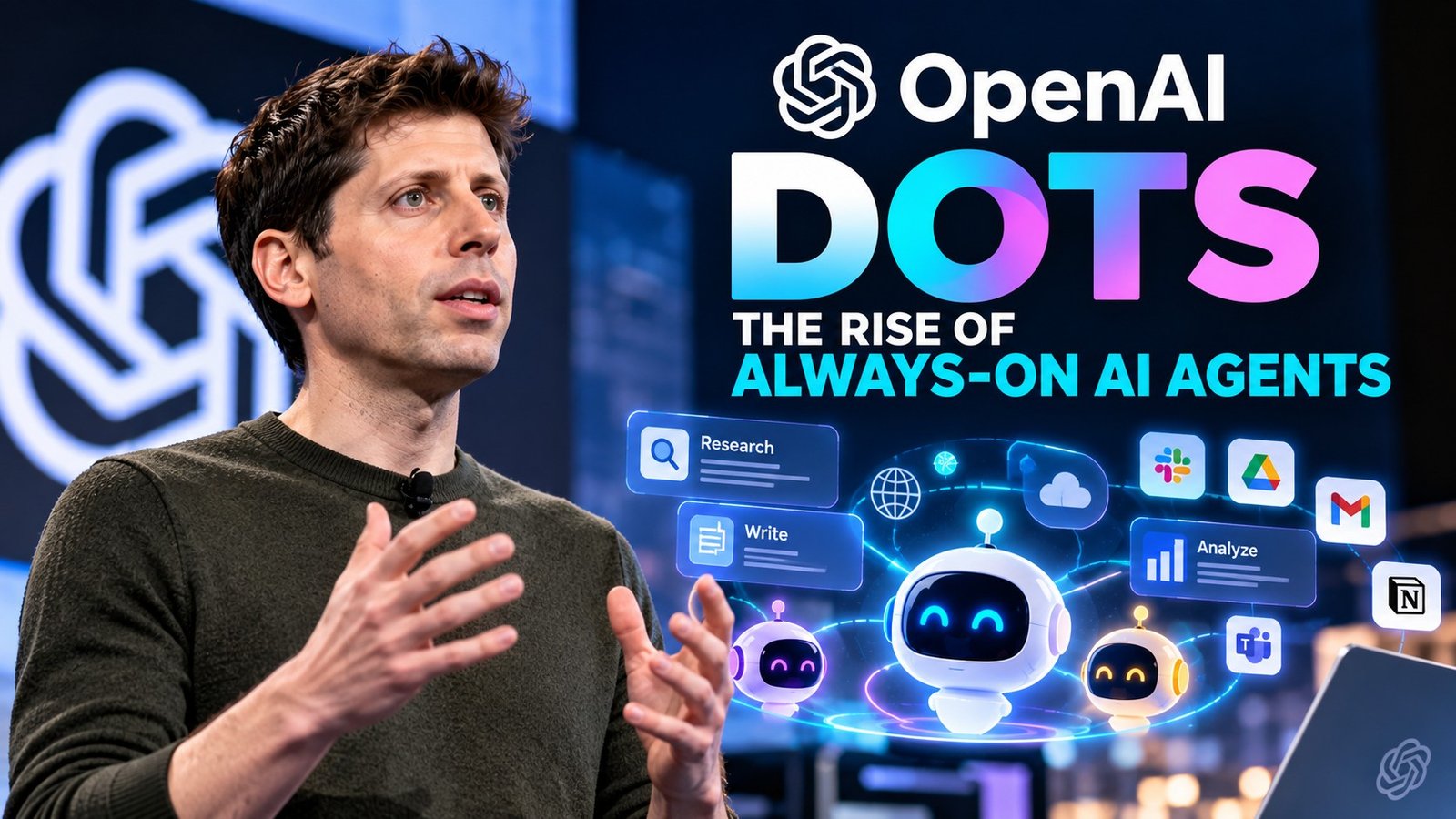
OpenAI is moving AI beyond the chatbot era with Dots, a new generation of always-on AI agents designed to take responsibility for tasks, work in the background and return to users when human judgment is required.
OpenAI unveiled Dots at its DevDay 2026 event in San Francisco on September 29, introducing a new approach to personal and professional AI assistance. Rather than waiting for users to open a conversation and provide instructions each time, Dots are designed to remain active and continue working toward a user’s goals.
Powered by OpenAI’s GPT-6 Astra model, each Dot operates with its own cloud computer and web browser. It can interact with connected applications, conduct research, work through multi-step assignments and maintain context across ongoing projects.
From Chatbots to AI Agents
Traditional chatbots generally operate around individual conversations: a user asks a question, receives an answer and decides what to do next.
Dots represent a different model.
A user can give a Dot a broader objective and allow it to determine the steps required to make progress. The agent can continue working after the user closes the chat and return with updates, completed work or questions when a decision requires human involvement.
OpenAI describes this as an always-on AI agent that can take ongoing responsibility rather than simply responding to individual prompts.
This shift is significant because it changes the role of AI from an information provider into a system capable of performing continuing digital work.
Dots Can Work Across Applications
One of the most important capabilities of Dots is their ability to connect with external applications.
OpenAI says Dots can work with more than 4,000 applications, while communication can take place through ChatGPT and workplace platforms such as Slack and Microsoft Teams. The system is also designed to preserve context across different channels.
This could allow a Dot to become a persistent digital assistant for activities such as:
- Research and information gathering
- Project management
- Content development
- Software and website work
- Preparing meetings and appointments
- Monitoring ongoing projects
- Organizing information across applications
- Following up on assigned tasks
Instead of repeatedly moving information between different applications, users can increasingly delegate the workflow to an AI agent.
Each Dot Has Its Own Cloud Computer
Another major difference between Dots and conventional AI assistants is the computing environment behind the agent.
Each Dot receives access to a dedicated cloud computer and browser. This gives the agent an environment in which it can perform digital tasks rather than simply generating text inside a conversation.
The concept points toward a future where users may delegate complete digital workflows to AI.
For example, rather than asking an AI to explain how to build a website, a user could give the agent a goal such as developing a website and allow it to research requirements, work through the necessary steps and return the results for review.
Dots Learn From User Preferences
OpenAI also designed Dots to become more useful through continued interaction.
The company says Dots can learn a user’s preferences, working style and expectations over time. This means an agent could potentially become increasingly familiar with how an individual or organization wants tasks completed.
This personalization could be particularly valuable for repetitive professional workflows.
A marketing professional, for example, could establish preferred writing styles, research criteria and reporting formats. A Dot could then apply those preferences to future assignments rather than starting from scratch every time.
Humans Remain in the Loop
Despite their autonomous design, Dots are not intended to operate without boundaries.
OpenAI says users can establish permissions and rules governing what an agent can do independently and which actions require approval. The system is designed to bring work back to the user when human judgment is needed.
That distinction is important.
The future of AI agents is not simply about making systems more autonomous. It is also about determining where autonomy should stop.
Giving an AI access to email, workplace applications, documents and other services creates significant opportunities, but it also creates new security and privacy responsibilities.
OpenAI Takes on the AI Agent Competition
The launch of Dots comes as competition in AI agents intensifies.
OpenAI’s announcement follows the emergence of Meta’s Muse, another AI assistant designed to perform tasks on behalf of users. Other companies are also developing systems that can interact with software and complete multi-step workflows.
Dots therefore represent more than another ChatGPT feature. They are part of a broader industry transition from conversational AI toward agentic computing.
The competitive question is increasingly becoming not simply which AI model can answer questions most accurately, but which AI system can reliably accomplish useful work with minimal human intervention.
Initial Availability
OpenAI says Dots are rolling out gradually.
The initial rollout includes ChatGPT Pro users in eligible markets, while Business Premium users can access Dots in supported ChatGPT regions. Enterprise users can access a beta when their workspace administrator enables it. OpenAI says access is being expanded gradually.
At launch, users can create a primary Dot, while OpenAI has indicated that more advanced multi-agent capabilities are planned.
What Dots Could Mean for Businesses
For businesses, the implications could be substantial.
Companies already use AI for writing, customer support, coding, research and data analysis. Persistent agents could combine these individual capabilities into longer-running workflows.
A business could potentially assign an agent responsibility for monitoring a project, gathering information, preparing reports and alerting employees when decisions are required.
This could reduce the amount of time employees spend on repetitive digital coordination.
However, organizations will also need stronger controls around data access, permissions, auditing and accountability. An AI system that can act across many applications creates a fundamentally different risk profile from a chatbot that only generates text.
The Bigger Shift: AI That Keeps Working
The most important aspect of Dots may not be the visual design of the agents or even the underlying model.
It is the concept of persistent AI responsibility.
Today’s AI assistants generally wait for instructions. Dots are designed to continue working toward an objective after the initial conversation ends.
That creates a new model of human-computer interaction:
Instead of telling AI what to do every time, users increasingly tell AI what they want accomplished.
The AI then determines the steps, performs the work, asks for guidance when necessary and returns the results.
The Beginning of an Agentic AI Era
OpenAI’s Dots launch signals another stage in the evolution of artificial intelligence.
The first generation of generative AI made it possible for machines to produce text, images, code and other content. The next generation is increasingly focused on taking action.
If these systems become reliable, secure and sufficiently controllable, AI agents could become a new layer of digital infrastructure—working alongside employees rather than simply answering their questions.
Dots are an early example of that direction.