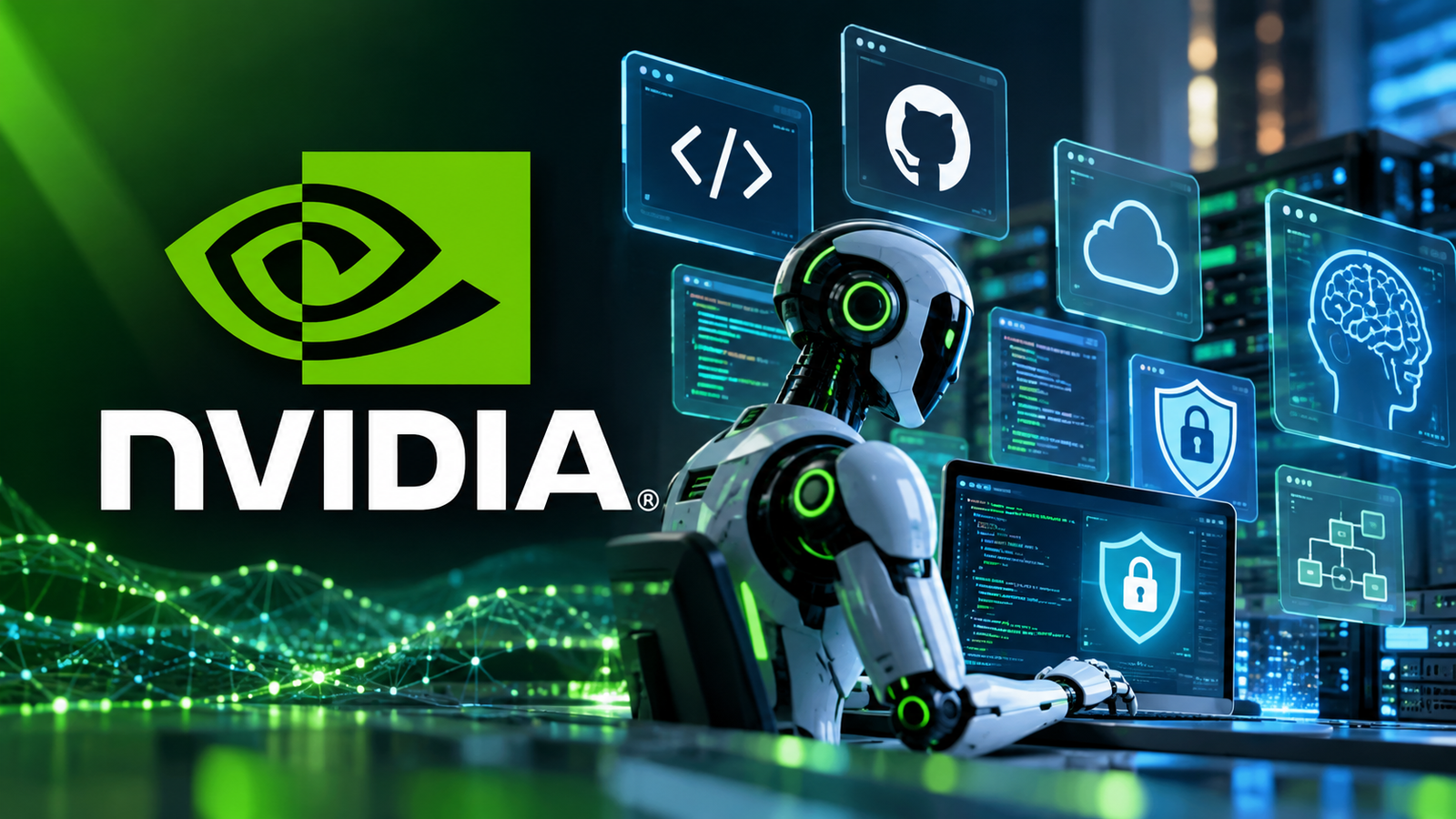
NVIDIA is expanding its approach to AI-agent security with open-source software designed to give organizations greater control over autonomous systems as they move from experimentation into real-world workflows.
AI agents are rapidly evolving beyond systems that simply generate text or answer questions. Modern agents can access files, use external tools, execute code, interact with enterprise applications and perform multi-step tasks with limited human intervention. That growing autonomy also introduces a new security challenge: organizations need to control not only what an AI model produces, but what an agent is actually allowed to do.
NVIDIA is addressing this challenge through an expanding portfolio of open-source technologies, including NVIDIA OpenShell, an open-source runtime designed to provide security, privacy and policy controls around autonomous AI agents. NVIDIA says OpenShell is intended to enforce restrictions at the infrastructure layer rather than relying exclusively on the AI model or application itself.
Moving Security Outside the AI Model
Traditional AI security approaches often concentrate on the model layer: detecting malicious prompts, filtering outputs or adding application-level guardrails. Agentic AI introduces additional risks because an agent can take actions in external environments.
An agent with access to a company’s files, credentials or network could potentially perform actions beyond what its user intended if its permissions are poorly controlled.
OpenShell is designed to create a controlled runtime environment around agents. NVIDIA describes capabilities including sandboxed execution, filesystem restrictions, network controls, process restrictions and controlled access to credentials and external providers.
Open-Source Infrastructure for Agent Security
A significant element of NVIDIA’s strategy is its use of open-source software.
The company’s OpenShell project is publicly available through GitHub, allowing developers to examine and work with the runtime rather than treating the security layer as a completely closed component. The project supports sandbox environments and policy-based controls intended to restrict filesystem, network and process activity.
This approach reflects a broader movement toward open security infrastructure for AI. NVIDIA and other technology companies have also established the Open Secure AI Alliance, an industry initiative focused on developing and sharing open technologies for AI safety and cybersecurity.
The alliance’s work includes areas such as vulnerability detection, identity, permissions, isolation, logging, software scanning, guardrails and evaluation of AI-agent behavior.
Why AI Agents Need a Different Security Model
The security requirements for an AI chatbot and an autonomous agent are fundamentally different.
A chatbot might provide an incorrect answer. An autonomous agent can potentially take an incorrect action.
For example, an enterprise coding agent could access a repository, modify files, execute commands and communicate with external services. A research agent could retrieve information from the internet and store it in company systems. A business automation agent could interact with customer or financial systems.
The greater the agent’s ability to act, the more important it becomes to establish boundaries around its permissions.
This is where infrastructure-level security can become important. Rather than asking an AI model to decide whether an action is safe, an external security layer can impose technical restrictions on what the agent is actually capable of doing.
Policy-Based Controls
NVIDIA’s OpenShell uses declarative policies to control an agent’s environment.
According to the project’s documentation, the system can control four major areas:
- Filesystem access — restricts which files and directories an agent can access.
- Network activity — controls outbound connections.
- Process activity — limits potentially dangerous system operations.
- Provider access — controls how credentials and external AI services are accessed.
This creates a model in which an AI agent can remain highly capable while operating inside a defined security boundary.
The concept is similar to sandboxing used in traditional computing, but adapted for systems that can dynamically use AI models, tools and external services.
From Development to Enterprise Deployment
NVIDIA announced its Agent Toolkit in March 2026 as an open-source software platform for enterprises and developers building autonomous AI agents. OpenShell became part of that toolkit as a runtime for improving agent safety, security and governance.
The company has also introduced NVIDIA NemoClaw, a stack built around the OpenClaw agent platform that combines NVIDIA’s Nemotron models with OpenShell security and privacy controls.
Together, these projects indicate that AI-agent infrastructure is becoming a major software category in its own right.
The emerging stack increasingly includes not just models, but also:
Models → Agents → Tools → Runtime → Security Policies → Infrastructure
That shift could become increasingly important as businesses deploy agents capable of performing work rather than simply assisting employees.
An Industry-Wide Security Challenge
NVIDIA’s initiative is part of a larger industry response to the security challenges surrounding increasingly autonomous AI systems.
The Open Secure AI Alliance brings together organizations from areas including cloud infrastructure, cybersecurity, enterprise software and AI. Its stated objective is to develop and share open technologies that can help identify vulnerabilities and strengthen the security of AI systems and agents.
The emphasis on open technologies is significant because AI-agent deployments frequently involve multiple vendors. An organization might use one model provider, another cloud platform, third-party APIs and several agent frameworks.
Security controls that work only within one vendor’s ecosystem may therefore be insufficient for complex enterprise environments.
Open standards and interoperable security technologies could help organizations establish consistent controls across those environments.
The Road Ahead for Agentic AI
AI agents are moving toward a future in which software systems can independently plan tasks, use tools and interact with digital infrastructure.
That creates enormous opportunities for automation, but it also changes the definition of AI security.
The question is no longer simply:
“Can we make the AI model safer?”
It is increasingly:
“What can the AI system actually do, and what prevents it from exceeding those boundaries?”
NVIDIA’s open-source security initiatives represent one approach to answering that question. By placing controls around the runtime and infrastructure supporting an AI agent, organizations can establish technical boundaries that operate independently of the model’s own behavior.
Open-source projects such as OpenShell could therefore become part of a broader security architecture for the agentic era. Their long-term impact will depend on adoption, interoperability, independent security review and how effectively these controls perform as AI agents become more capable.
One thing is already becoming clear: as AI agents gain the ability to act, security will have to evolve from protecting AI outputs to controlling AI actions.
NVIDIA’s open-source security strategy highlights a broader transition in artificial intelligence. The next generation of AI systems will not simply generate information—they will increasingly interact with software, data and real-world infrastructure.
That makes security boundaries essential.
Open-source runtimes, sandboxing, policy enforcement, identity controls and independent monitoring could become foundational components of enterprise agent infrastructure. NVIDIA’s work is one significant contribution to that emerging ecosystem, while the wider industry continues to determine how autonomous AI can be made both powerful and controllable.