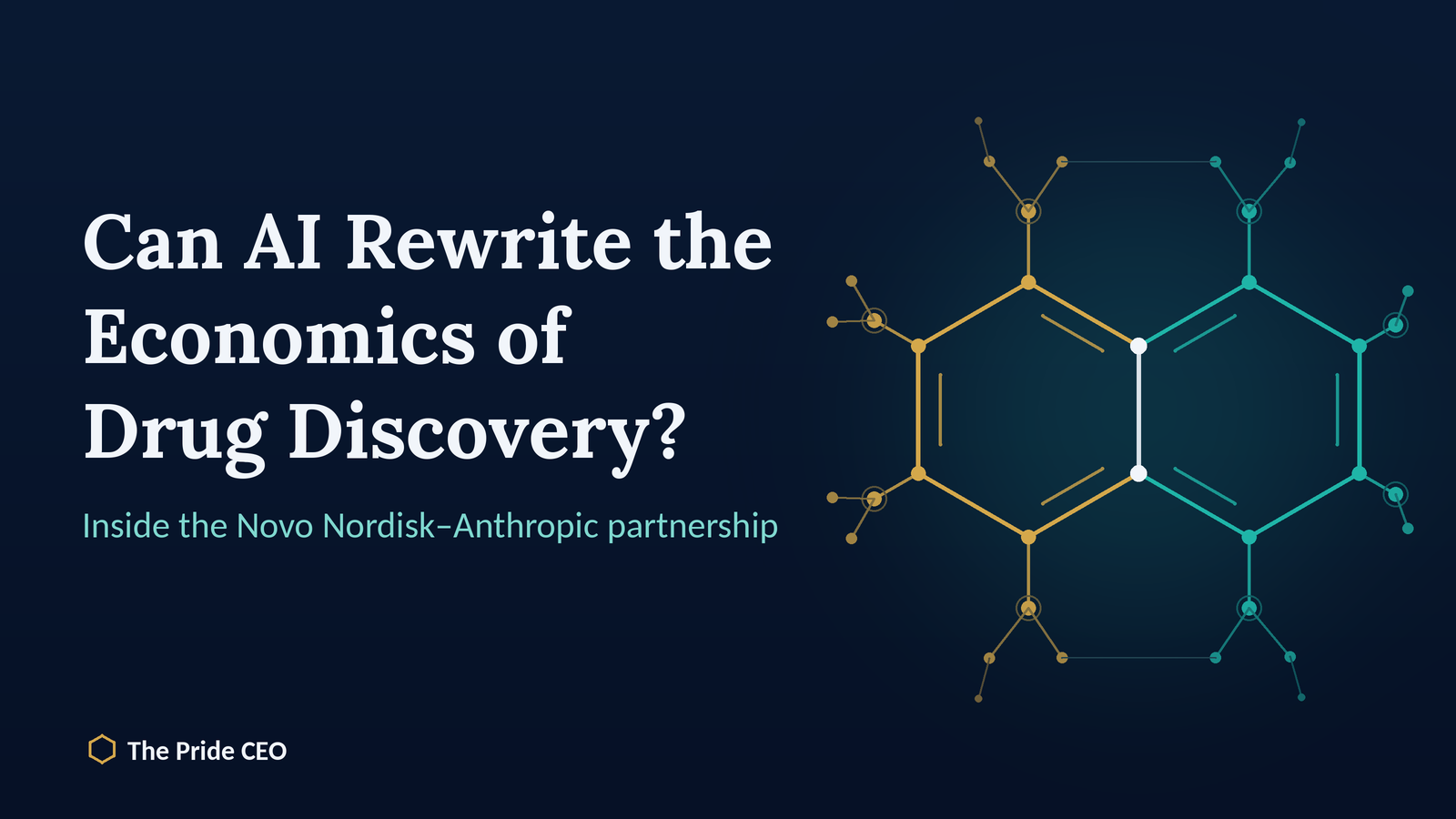
On 16 September 2026, from its headquarters in Bagsværd, Denmark, Novo Nordisk announced a collaboration with Anthropic that puts one of the world’s most valuable pharmaceutical companies alongside one of the leading frontier AI developers. The stated goal is simple to say and hard to achieve: accelerate the discovery and development of new medicines.
For the executive audience, the deal is worth reading closely for what it says about where enterprise AI is heading. Novo Nordisk is not running a single pilot with a single vendor. It is assembling a portfolio of AI partnerships, pointing each at a different part of the business, and wrapping all of them in governance. That approach, more than any individual announcement, is the story.
What Was Announced
Under the agreement, Novo Nordisk will use Anthropic’s frontier models, including the company’s Claude Science workbench, to support research and development. According to the announcement, the two companies will jointly address drug discovery challenges identified by Novo’s scientists and computational teams, build targeted solutions for specific scientific workflows, and support biological reasoning, the process by which researchers form and test hypotheses about how disease works and how a molecule might change it.
The rollout begins deliberately small. Novo Nordisk plans to test Claude Science in selected R&D workflows, concentrating on problems where the two organisations believe their combined expertise can make the greatest difference. A second strand of the partnership reaches beyond the laboratory: Novo will also use Anthropic’s models to strengthen AI-driven software development across the enterprise.
Several details were not disclosed. The financial terms are private. No specific drug candidates or clinical programmes have been tied to the collaboration, and neither company has published quantitative targets for productivity gains or shorter development timelines. Readers should treat the announcement as a statement of intent and a framework for testing, not as evidence of results.
The Problem AI Is Being Asked to Solve
To understand why a pharmaceutical leader would make this bet, start with the economics of drug development. Bringing a new medicine to market has long taken more than a decade and, by widely cited estimates from the Tufts Center for the Study of Drug Development, costs billions of dollars once the price of failed candidates is included. Most compounds that enter clinical trials never reach approval.
Researchers have a name for the paradox at the centre of this: Eroom’s law, a play on Moore’s law in reverse. In a 2012 paper in Nature Reviews Drug Discovery, Jack Scannell and colleagues observed that the number of new drugs approved per billion dollars of R&D spending had roughly halved every nine years for decades, despite enormous advances in genomics, screening technology and computing power. More data and better tools had not automatically produced more medicines.
The bottleneck, many scientists argue, is not a shortage of data but the difficulty of reasoning across it. A single research question can touch genomic databases, protein structures, chemical libraries, published literature and internal experimental results, each held in a different format and understood by a different specialist. Much of a researcher’s time goes to stitching these sources together. This is where large language models and agentic AI systems are being tested: as tools that can read, connect and reason across that fragmented landscape at a speed no individual team can match.
Novo Nordisk’s chief executive, Mike Doustdar, framed the opportunity in two parts. The first is productivity: AI can raise output in R&D and shorten the route from research to a marketed product. The second is more ambitious. He said AI tools may open entirely new scientific opportunities and improve researchers’ understanding of human biology and the mechanisms of drugs. In other words, the aim is not only to do existing work faster, but to see things that were previously hard to see.
Inside Claude Science
The centrepiece of the initial work is Claude Science, which Anthropic launched as a research workbench for scientists. According to reporting on the launch, it connects to more than 60 scientific databases and includes prebuilt toolkits for fields such as genomics, proteomics, structural biology and cheminformatics. Those four disciplines span much of the early-stage discovery pipeline, from identifying and validating a biological target, to understanding protein structure, to designing and evaluating candidate molecules.
The design logic is worth noting. Rather than asking a general-purpose chatbot to answer scientific questions from memory, a workbench of this kind places the model inside the researcher’s actual environment, with access to the databases and analytical tools scientists already rely on. For a company like Novo Nordisk, whose scientists work with both public resources and proprietary data, the promise is an assistant that can be pointed at a specific problem and held accountable for showing its work.
Anthropic’s chief executive, Dario Amodei, offered the broader vision in the announcement, saying AI’s growing capability could “compress a century’s worth of biological and medical breakthroughs into a decade.” He added that giving leading researchers access to safe, capable and trusted frontier models can shorten research timelines and improve outcomes. It is a large claim, and the industry will judge it by what emerges from real programmes over the coming years rather than by the ambition of the language.
Beyond the Lab: Software, Documentation and Scale
The software development strand of the agreement deserves as much attention as the science. Modern pharmaceutical R&D runs on code: data pipelines, analysis environments, simulation tools and the internal platforms that connect them. Faster, better software development means faster scientific tooling.
Novo Nordisk is not starting from zero here. According to an Anthropic case study, the company has already built NovoScribe, an AI-powered documentation platform developed with Claude Code on Amazon Bedrock and MongoDB Atlas. It combines retrieval-augmented generation with text approved by domain experts and case-specific variables to produce regulatory documentation. Regulatory submissions are one of the most labour-intensive parts of getting a drug to market, which makes them a natural early target for automation that keeps a human expert in the approval loop.
The lesson for enterprise leaders is that the visible, headline-friendly use case, in this case discovering drugs, often rests on a quieter foundation of engineering and operational AI that has already proven its value. Organisations that begin with well-bounded internal workflows tend to build the trust, skills and infrastructure needed for higher-stakes applications later.
A Deliberate Multi-Partner Strategy
The Anthropic collaboration is the third major AI partnership Novo Nordisk has announced this year. In April, the company entered a strategic partnership with OpenAI aimed at applying advanced AI to complex datasets, identifying promising drug candidates and reducing the time required to move from research to patient. That agreement also covers upskilling Novo’s global workforce and improving efficiency in manufacturing, supply chain, distribution and corporate operations. In August, Novo and Amazon Web Services announced a partnership to accelerate drug discovery and modernise operations through agentic AI and cloud technologies, including a co-innovation hub in London where engineers and scientists from both organisations work together.
Read together, these deals describe a strategy rather than a series of purchases. Novo Nordisk has said it wants to become “the world’s most AI-driven healthcare company”, and it appears to be pursuing that goal by working with several leading technology providers at once, each contributing different strengths: a frontier model developer, a second frontier model developer, and a hyperscale cloud provider.
There are sound reasons for this. No single AI vendor is likely to lead in every scientific domain, and models improve at different rates. A multi-partner approach reduces dependency risk, encourages competition on quality and price, and lets the organisation learn which tools perform best on which problems. It also carries costs: integration complexity, duplicated effort and the need for strong internal coordination so that lessons from one partnership inform the others. Executives considering a similar path should budget for that coordination as seriously as they budget for the technology.
Governance in a Regulated Industry
Pharmaceutical companies operate under some of the strictest regulatory regimes in the world, and Novo Nordisk has been explicit that governance is built into the collaboration. The company says the partnership includes robust data governance and human oversight, intended to ensure AI is applied responsibly and in line with its ethical and compliance standards. The earlier OpenAI agreement was structured with similar provisions.
This matters for two reasons. First, drug development involves proprietary research data, sensitive patient-related information and regulatory obligations, so how a model is deployed, what data it can see and who reviews its outputs are central design questions. Second, scientific credibility depends on traceability. A result that cannot be explained, reproduced and checked by a human expert has limited value in a process where regulators, clinicians and patients ultimately rely on the evidence.
Human oversight is therefore not a brake on the technology’s usefulness but a condition of it. The most credible deployments in regulated sectors treat AI as an accelerator of expert judgement, not a replacement for it.
What We Do Not Yet Know
Balanced coverage requires stating the limits of the announcement plainly. There are no disclosed drug candidates, no clinical programmes linked to the deal, and no published metrics for how much faster or cheaper discovery might become. AI has helped speed certain early-stage tasks across the industry, but the harder test lies further downstream: whether AI-assisted discovery produces molecules that succeed in human trials at higher rates than conventional methods. That evidence will take years to accumulate.
It is also worth noting that the initial phase is a testing phase. By starting with selected workflows and problems, Novo Nordisk is signalling that it intends to measure benefit before scaling. That is sensible discipline, and it suggests the company will have more concrete findings to share as the work matures.
Five Takeaways for Enterprise Leaders
1. Start narrow, measure honestly. Novo Nordisk is beginning with chosen problems and workflows where benefit can be assessed, rather than announcing an organisation-wide transformation.
2. Build a portfolio, not a dependency. Partnering with multiple AI providers spreads risk and speeds learning, provided leadership invests in coordination.
3. Treat governance as a design input. In regulated industries, data protection and human oversight determine whether AI can be used at all, so they belong in the architecture from the first day.
4. Do not overlook the engineering layer. Software development and documentation automation can deliver early, measurable returns and create the foundation for more ambitious applications.
5. Frame the goal as capability, not just cost. Doustdar’s emphasis on new scientific opportunities, not only efficiency, points to where the greatest long-term value may lie: enabling people to do work that was previously out of reach.
The Bottom Line
Novo Nordisk built its position on treatments for chronic conditions such as diabetes and obesity, and it has said the mission behind this partnership is to bring new, transformative health solutions to people living with chronic diseases. Whether AI can meaningfully bend the long-standing cost and time curves of drug development is still an open question, and no announcement can answer it.
What the Anthropic collaboration does show is how a leading enterprise is choosing to find out: with several partners, in staged experiments, under clear governance, and with a stated ambition that goes beyond efficiency. For business leaders in every sector, that combination of ambition and discipline is a template worth studying, whatever the eventual results in the laboratory.