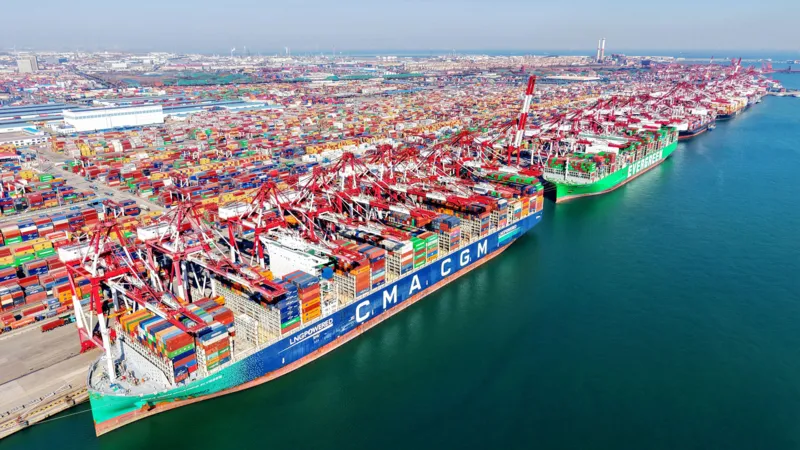
Asian shares slid on Monday morning after US President Donald Trump followed through on his promise to impose tariffs on Canada, Mexico and China.
Investors are bracing for a turbulent period that could hit the earnings of major companies and dent global growth.
Canada and Mexico have said that they will hit back with retaliatory tariffs while China promised “corresponding countermeasures” and vowed to challenge Trump’s move at the World Trade Organization.
Trump has said the tariffs are necessary to halt the flow of illegal drugs and immigration into the US.
Hong Kong’s Hang Seng Index was down 0.7%, Japan’s Nikkei 225 was 2.8% lower, South Korea’s Kospi tumbled 3% and Australia’s ASX 200 fell 1.9%.
Markets in mainland China remained closed for the Lunar New Year holiday.
Meanwhile, the US dollar was showing strength, rising to a record high against China’s yuan, while the Canadian dollar plunged to its lowest level since 2003.
“The prospect of having a long and protracted trade spat between the world’s two biggest economies is causing investors to take risk off the table today,” said Tim Waterer, chief market analyst at financial services firm KCM Trade.
“The other worry for investors is which countries may be on Trump’s tariff hit list next”.
The tariffs announced by the Trump administration over the weekend target the United States’ three largest trading partners and the US president has threatened he might not stop there.
Trump has also vowed to impose tariffs on the European Union “pretty soon”.
Chief investment strategist at investment bank Saxo, Charu Chanana, warned that while tariffs could be beneficial for the US economy in the short term, in the long run they pose significant risks.
“Repeated use of tariffs would incentivise other countries to reduce reliance on the US, weakening the dollar’s global role,” she added.
Trump has said he will speak to Canada and Mexico’s leaders on Monday about the tariffs which are due to come into effect at midnight on Tuesday.
The two countries are facing tariffs of 25% on their exports to the US, while Chinese goods will face an additional 10% tax.